Aidenn
The RavenAidenn is the distant, imagined realm in which the narrator hopes that reunion with Lenore might still be possible. It is not presented as an ordinary geographic place but as an answer to bereavement: a sacred elsewhere where the “soul with sorrow laden” might encounter the “sainted maiden” whom the Angels name Lenore. Its decisive significance lies in the way the poem makes this hope depend on a question addressed to the Raven, whose answer transforms a possible afterlife into an inaccessible horizon.
Definition and Setting
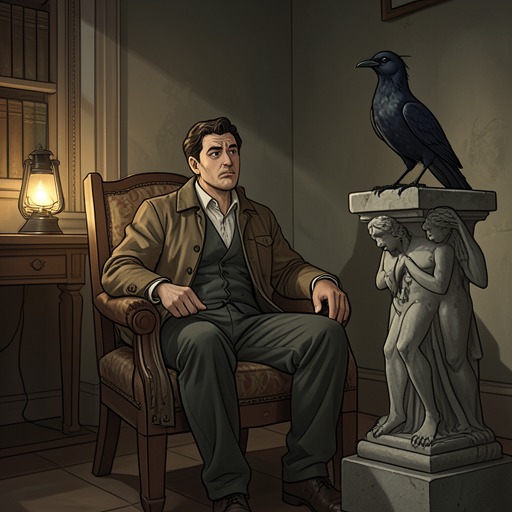
Aidenn appears late in the chamber scene, after the narrator has already moved from mourning into increasingly desperate interrogation. The setting remains the haunted room, yet the question reaches beyond it toward “the distant Aidenn,” establishing a sharp contrast between the enclosed interior and a remote spiritual world. The word therefore expands the poem’s spatial field without relieving its claustrophobia: the narrator can name a destination beyond the chamber, but he cannot approach it or verify its promise.
The place is associated with sacred imagery rather than concrete description. The narrator asks whether, within Aidenn, he will clasp a sainted and radiant maiden whom the Angels name Lenore. Aidenn consequently functions through expectation and relation: its identity is defined by the hoped-for presence of Lenore, not by landscapes, inhabitants, or visible architecture. The evidence offers no independent account of the realm, leaving it as a theological possibility shaped entirely by the narrator’s longing.
Aidenn and the Narrator’s Grief
The narrator’s appeal to Aidenn grows out of the earlier loss that governs the chamber scene. He has wished for the morrow and sought relief from sorrow in books, but those efforts have not released him from grief for Lenore. The remembered maiden is described as rare and radiant, and the Angels’ naming of her gives the loss a spiritual dimension before Aidenn is mentioned. His movement toward the afterlife is therefore not detached speculation: it is the next stage in an effort to find a place where mourning could become reunion.
That hope is also connected with the narrator’s wish for respite and forgetting. He imagines that the angels might have sent relief and nepenthe from his memories of Lenore, while the later question about Aidenn shifts the desired remedy from erasure to restoration. The two wishes pull in opposite directions. One seeks freedom from memory; the other seeks a future in which memory’s lost object can be recovered. Aidenn holds the second wish, preserving the narrator’s attachment to Lenore even as it exposes how little consolation his present world can provide.
The Question to the Raven
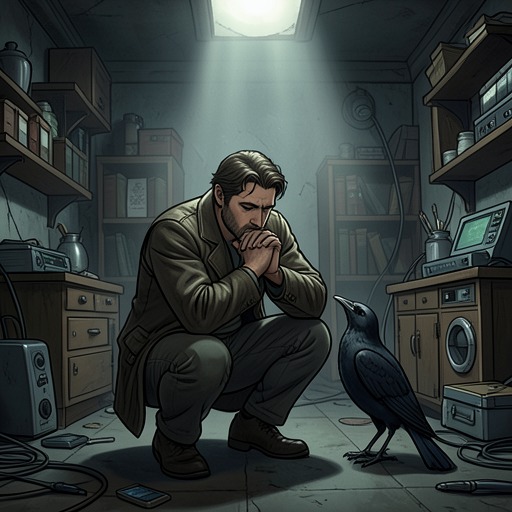
The narrator introduces the question in the Raven’s unstable role as either prophetic messenger or evil thing. He asks whether, within distant Aidenn, the sorrow-laden soul will clasp Lenore, repeating her description as a sainted, rare, and radiant maiden whom the Angels name. The repetition gives the question the structure of a final petition: the narrator does not merely seek information about a place, but demands confirmation that death has not permanently severed the relationship between himself and Lenore.
The Raven answers, “Nevermore.” Because the same word has already appeared as the bird’s response to an earlier question, its force is both formulaic and devastating. The bird does not describe Aidenn, dispute its existence, or explain the basis of its answer. It supplies only a negation whose meaning the narrator must enlarge. In the context of the question, “Nevermore” denies the anticipated clasp with Lenore and makes Aidenn function less as a promised destination than as the limit against which the narrator’s hope breaks.
Consequences and Narrative Significance
After hearing the answer, the narrator orders the bird to leave and calls for its return to the tempest and the Night’s Plutonian shore. The command treats the Raven as an intruder from a dark, mythic outside, yet it cannot remove the significance that Aidenn has acquired in the dialogue. The hoped-for afterlife has been placed under the authority of the bird’s repeated answer, and the narrator’s attempt to end the exchange cannot restore the possibility he had just asked to preserve.
Aidenn thus marks the poem’s movement from ordinary sorrow toward metaphysical despair. The room contains the immediate signs of mourning, including the memory of Lenore and the lamp-lit chamber; Aidenn supplies the distant promise that could give those signs a future meaning. But the Raven remains seated above the chamber door, its eyes seeming demonic, while its shadow lies across the floor and the narrator’s soul is understood through that shadow. The distant realm is never reached, and the surviving image is not reunion but confinement beneath a recurring answer.
Religious and Emotional Function
The religious vocabulary surrounding Aidenn places the narrator’s private grief within a larger language of angels, saints, balm, and spiritual consolation. He asks elsewhere whether there is balm in Gilead, and he imagines the Angels and Seraphim as possible agents of relief. Yet each sacred reference is tested by the Raven’s “Nevermore.” The poem does not provide an external divine voice to confirm Aidenn; instead, the narrator must address a mysterious animal whose answer may be prophecy, learned repetition, or a projection of his own despair.
For that reason, Aidenn remains simultaneously a place of hope and an instrument of loss. Its very distance allows the narrator to imagine reunion with Lenore, but that distance also makes the hope unreachable within the scene. When the Raven denies the possibility, it does not simply close a door in the chamber; it closes the imagined passage between present mourning and future consolation. Aidenn’s narrative role is therefore to give the final question its highest stakes: the answer concerns not merely where the dead might be, but whether grief can ever be answered by reunion rather than by permanent absence.